

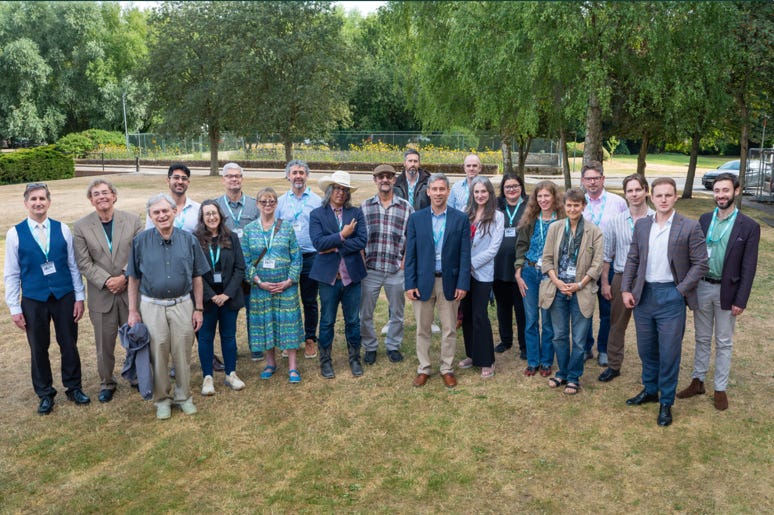
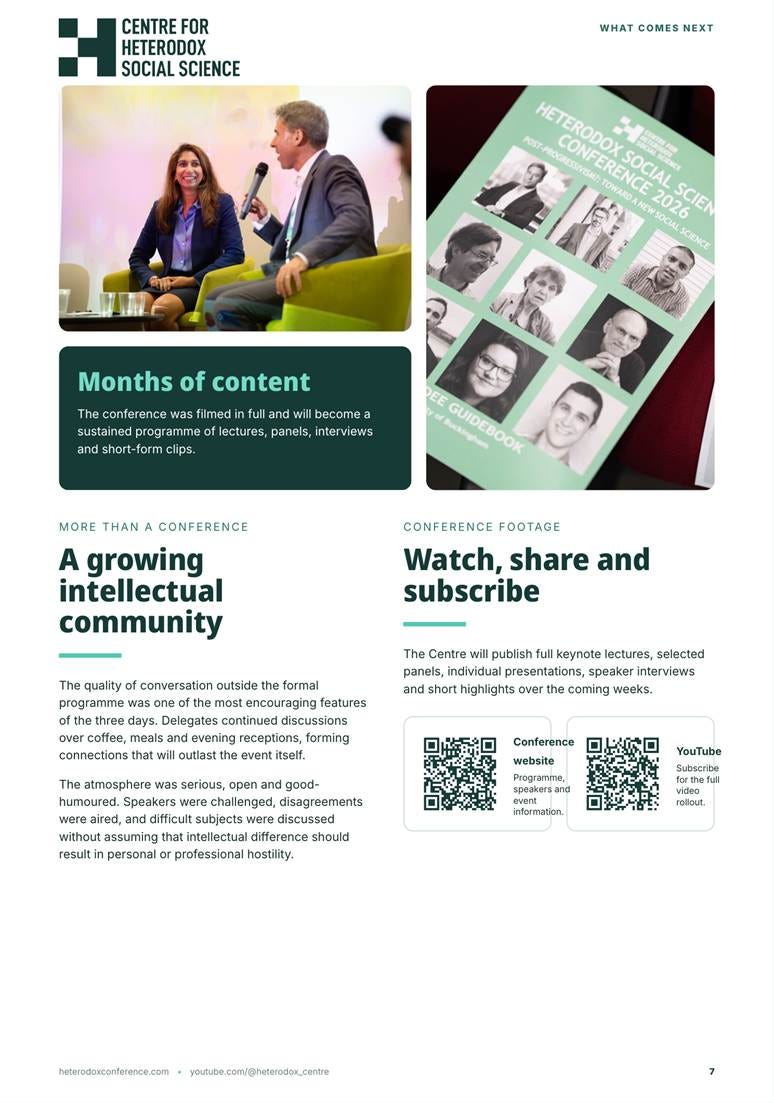
The Second annual Heterodox Social Science conference was held at the University of Buckingham July 23-25. It was a great success, carrying forth the intellectual energy, enthusiasm and focus of our inaugural conference in June of last year. Over the next few months, three times a week (Sunday, Tuesday, Thursday), we will be releasing live content from the conference which you can find our Centre’s YouTube page. This begins with the conference introduction (including my opening address), which you can watch here.
This conference differs from those which focus on free speech and inquiry (HxA, Stanford Academic Freedom Conference), even as there is important overlap. For our aim is not only to criticize academia’s capture by the progressive left and its departure from the path of academic freedom and truth, but to set out a concrete research agenda. Much like a specialist disciplinary conference.
This positive goal, as expressed in our Buckingham Manifesto of 2025 in the Chronicle of Higher Education (which you can sign here) involves two substantive pillars, ‘critical woke studies’ and heterodox social science. The first entails a scientific study of identitarian left ideology, with woke treated as an ideology like any other. This means rival schools of thought (for instance woke as self-interest v. woke as secular religion), theory-building, case studies and large-N analysis. It involves making sense of a torrent of new work from established figures (i.e. Musa al-Gharbi, Chris Rufo, Yascha Mounk) and upcoming scholars (i.e. Lars-Erik Gjerde, Collin May and Thomas Prosser), all of whom have spoken at our conferences.
The second involves heterodox social science: studying unfashionable or cancellable new topics, or neglected and forbidden perspectives on established topics. Consider this the roped-off area of the academic ski hill marked ‘danger: keep out.’ While the left part of the hill is heavily skied, the right run beyond the ropes is deep powder that beckons to be explored. For instance, studying how to reduce crime or improve social cohesion, assessing the genetic or evolutionary basis of human behaviour, treating the anxiety created by anti-white or anti-conservative discrimination. Or explaining race and sex achievement gaps through explanations such as family structure or the differing choices made by men and women at the tail end of their sex’s working hours bell curve. Many of our conference speakers address topics within this pillar, and the heterodox social science theme will continue to be central to our mission.
We aim to publish a new edited book on Post-Progressive Social Science next year. We have our 15 contributors signed up, complete with submission deadlines! This will be an exciting landmark volume blending bigger names with newer voices that hopefully will challenge the academy.
Developments, mainly in the United States, point to a broader recognition of the problem of conformity and weak viewpoint diversity in the social sciences and humanities. As reports by Yale and Vanderbilt/Washington University make clear, the echo chambers created by ideological conformity (enforced by radicals) have empowered woke extremists. This creates ‘critical’ (read: ideological) subsections of discipines which can becoming dominant in fields such as anthropology, sociology, literature and even parts of history. This constricts the freedom of dissenting activists to work free of emotional aggression, ostracism or even harassment by scholar activists. The latter enforces progressive conformity, narrowing knowledge, which in turn distorts our study of the social world. The Vanderbilt/Wash U report on the State of Sociology, by Jennifer Rubin (who spoke at this year’s conference), is especially noteworthy and a must-read.
A recent response has been the creation of a new $1 million annual prize by financier Bill Ackman and a panel of academic associates including Chancellor Diermeier. 5 awards of $1 million will be made to scholars ‘who have demonstrated intellectual independence, published findings that were attacked rather than answered, and been validated by the evidence—despite the professional cost.’ This year’s prizes will go to social scientists. I know I will be nominating several of our speakers. We need a lot more of these efforts if the ship of social science is to be turned around.
In my final presentation of the conference, I took stock of how far we have come. I outlined how the conference and my Centre fit within the broader transatlantic heterodox movement to reform the social sciences and humanities. Our special issue of Theory and Society, made up of contributions from last year’s speakers, is an important new marker. Another is the Centre’s Heterodox Research Award, which has funded 11 ongoing heterodox social science projects worth a collective £200,000.
Our next aim is to try and convince supportive government funders (perhaps the NSF in the US) to redirect funds toward heterodox social research. This is not affirmative action for libertarians and conservatives, but has a scholarly and pedagogical rationale. Namely, that conservative and classical liberal approaches, which have been ignored in both research and teaching, offer the best value for money when it comes to expanding the frontiers of relevant and useful knowledge in the social sciences.
Pursuant to this, I worked with Heterodox Academy (HxA) on a survey to tap the knowledge contained in HxA’s large social science and humanities membership. Our question: what are the topics and perspectives that have been neglected in your discipline, and has this occurred for political or ideological reasons? We received some 350 responses and the findings will be presented at the next HxA conference in April in Boston. A very partial sample of what came through appears below:
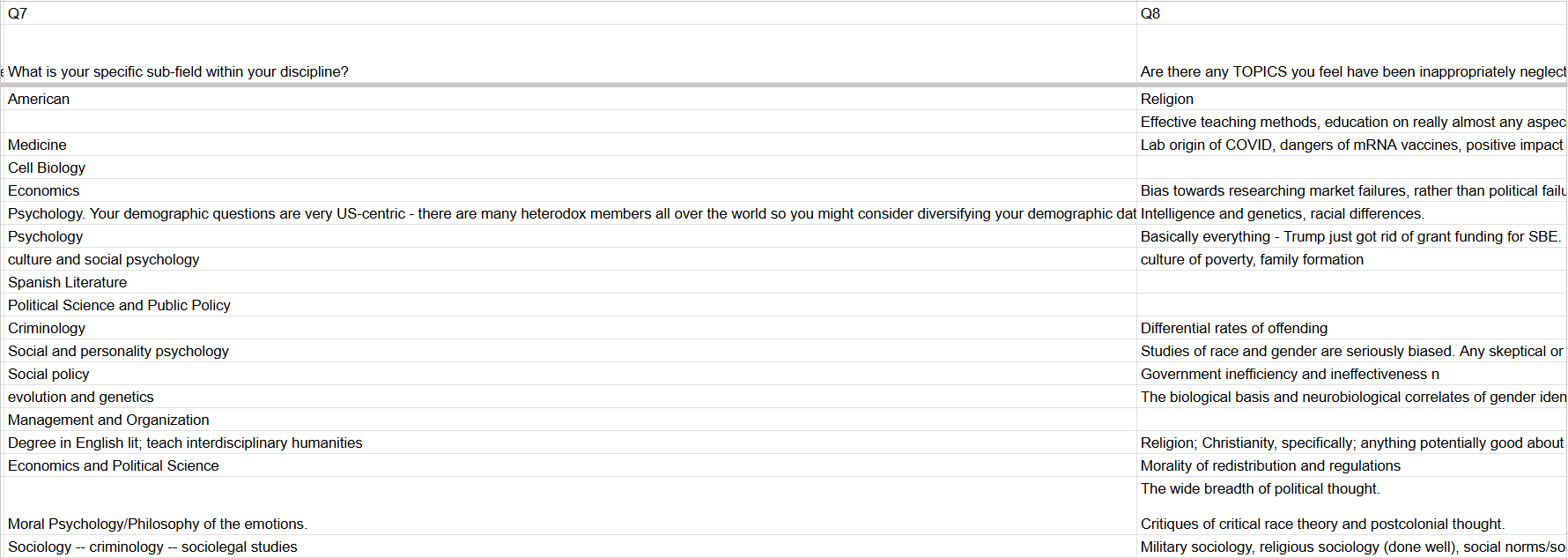
As Andrew Hartz mentioned during our second annual conference, constructing a topic list such as the one above will help university leaders - such as Vanderbilt Chancellor Daniel Diermeier , or perhaps those running Harvard, who claim to be raising funds for new viewpoint diversity Chairs (I’m not holding my breath!) - to hire unconventional scholars. A list can also guide future funders who wish to support unorthodox research in the social sciences and social humanities.
Finally, we are building a network of heterodox social scientists who can help supply us with non-progressive social science and humanities literature to build a database of alternative knowledge. Our emerging Heterodox Social Science Database will form a growing curated repository which we aim to make AI-searchable through a chatbot. If you know of important non-progressive books, articles or reports, please fill out this form which feeds directly into the database.
The goal is to build up a rigorous alternative research base to act as a counterweight to the dominant, ideologically-slanted, progressive knowledge-production system in academia. The new repository, modelled on existing sites like PhilPapers that blend a scholarly community with AI, can help academics, scholars, journalists, politicians and practitioners find the scholarship they need, countering dominant narratives. It can help compile reading lists and even textbooks.
The goal is not to displace existing knowledge, but to complement it, providing the missing parts of the picture or the countargument to the mainstream. Users can examine our output, weigh it against what they receive from mainstream AIs and academia, and make up their own minds in possession of the full set of facts and arguments.
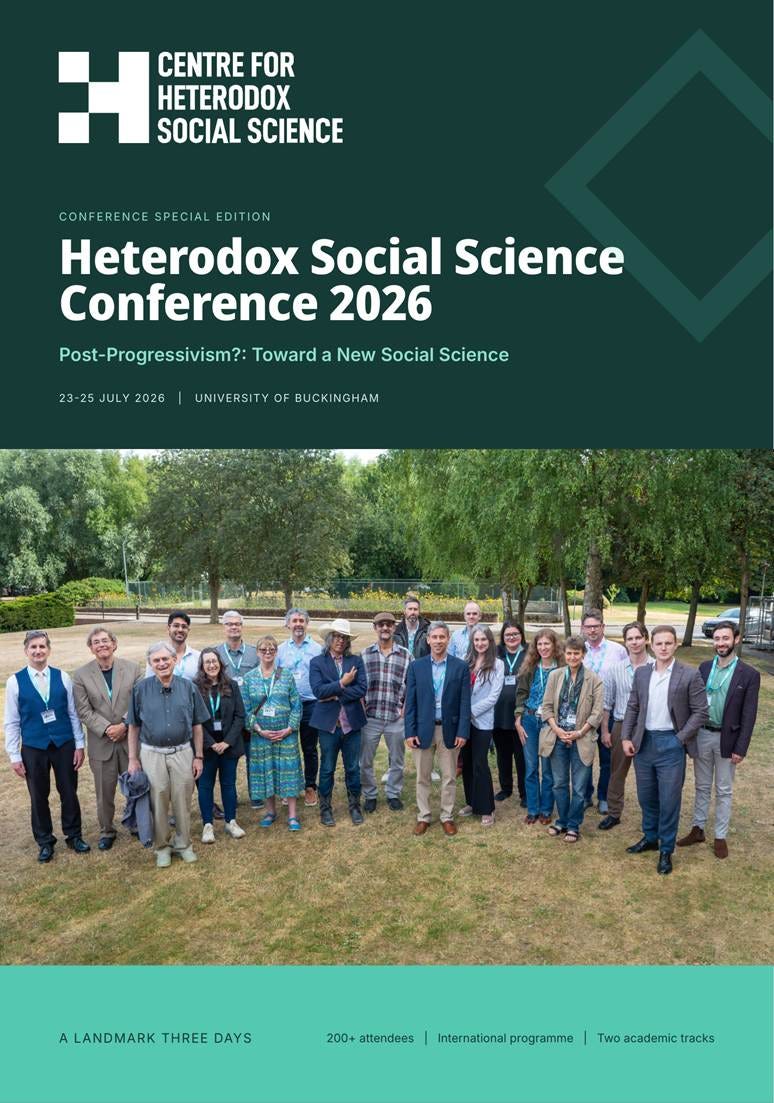
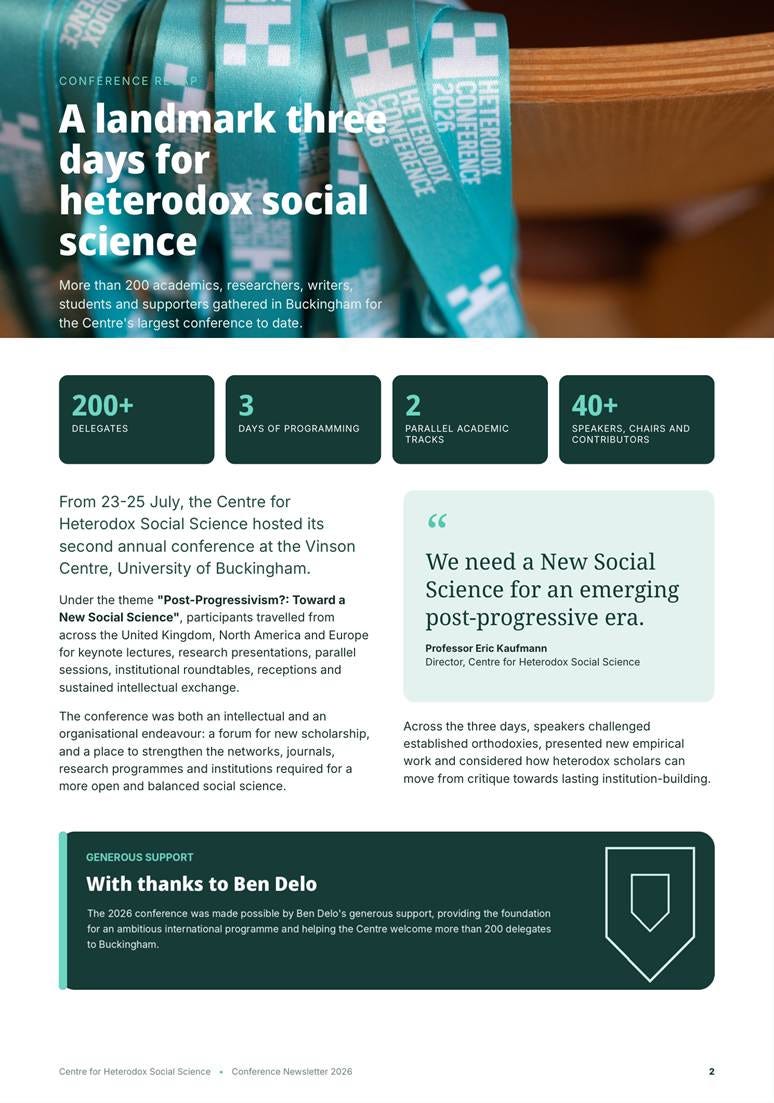
I leave you with our Centre newsletter:
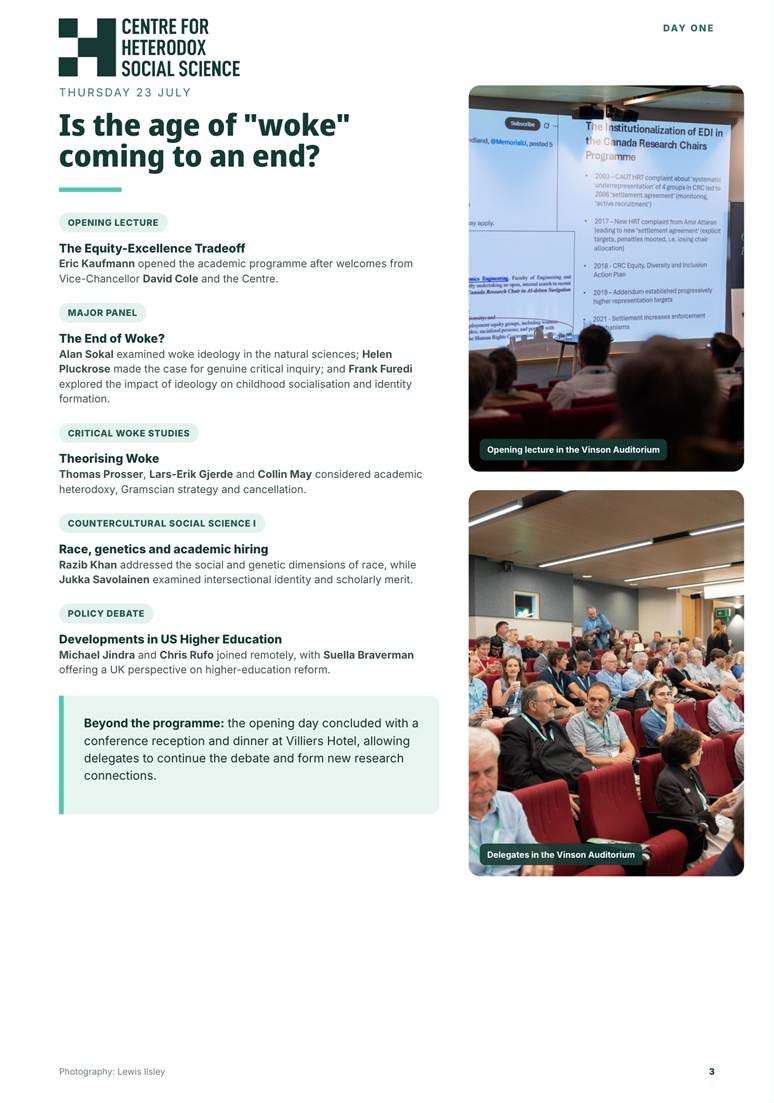
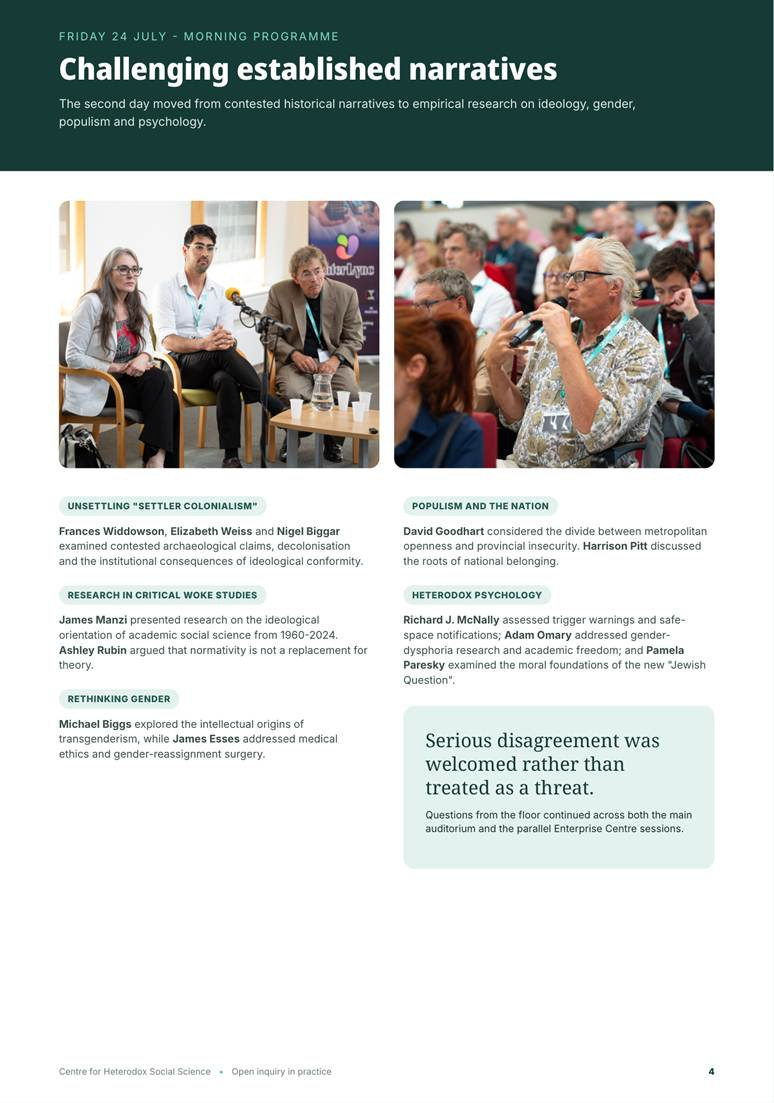
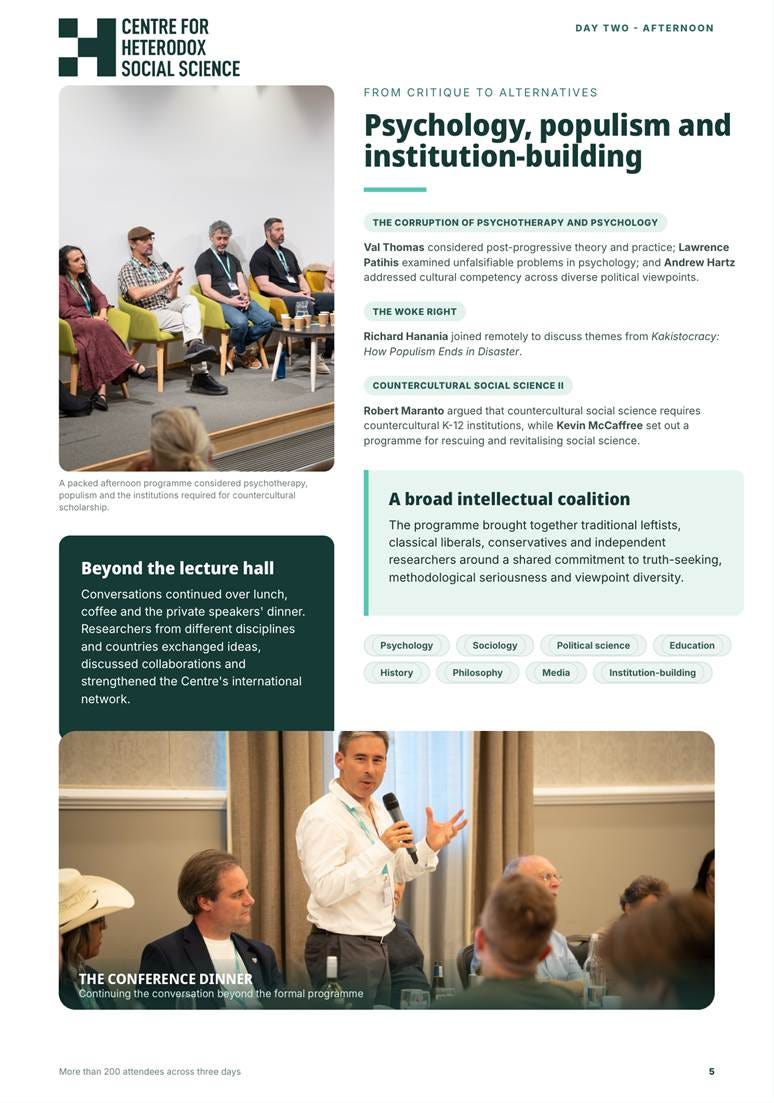
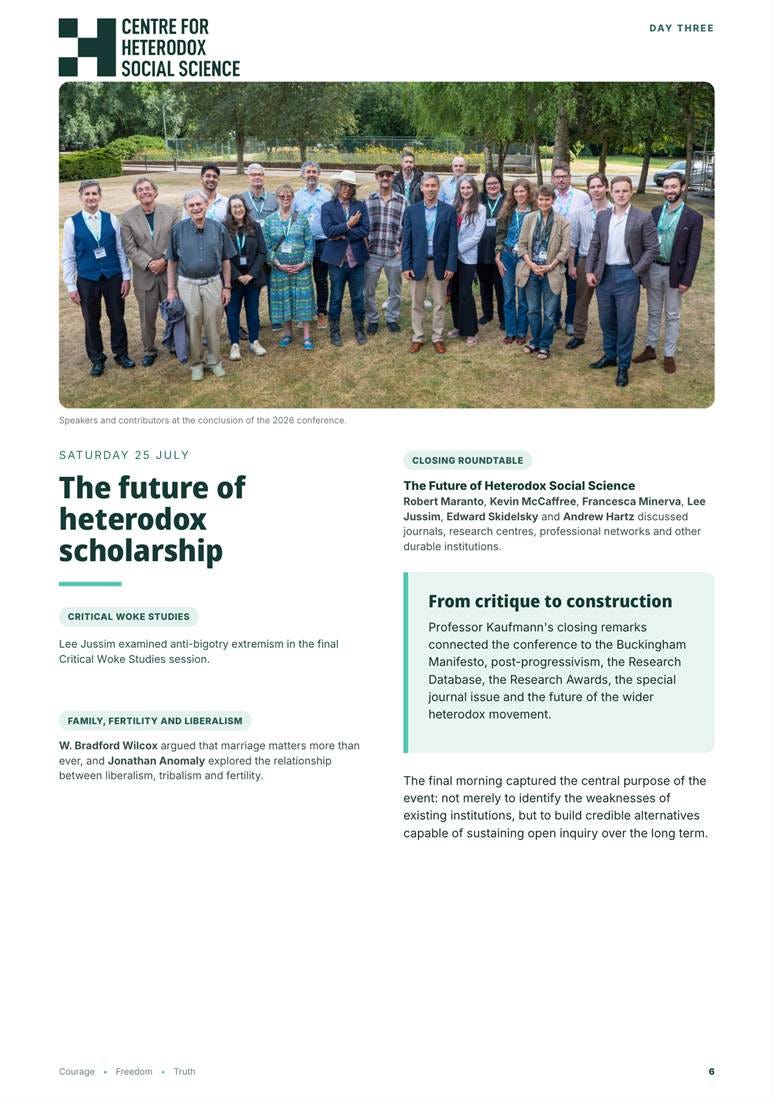
I thought it was another great conference, and I have just been too busy to write out more on the topic. Wonderful talks, and generally filled with good critical thinkers with a tendency towards quantitative social science and testability. The academics I saw at the conference tended to be people who care a lot about what is objectively true, and those who understand getting it wrong can do harm. The main reason for most of these hetereodox scholars speaking out, seems to be, ironically, preventing harm (categorized by Haidt as a liberal value), as well as some focused on conserving what is good.