
A guest post from Federico Tabellini
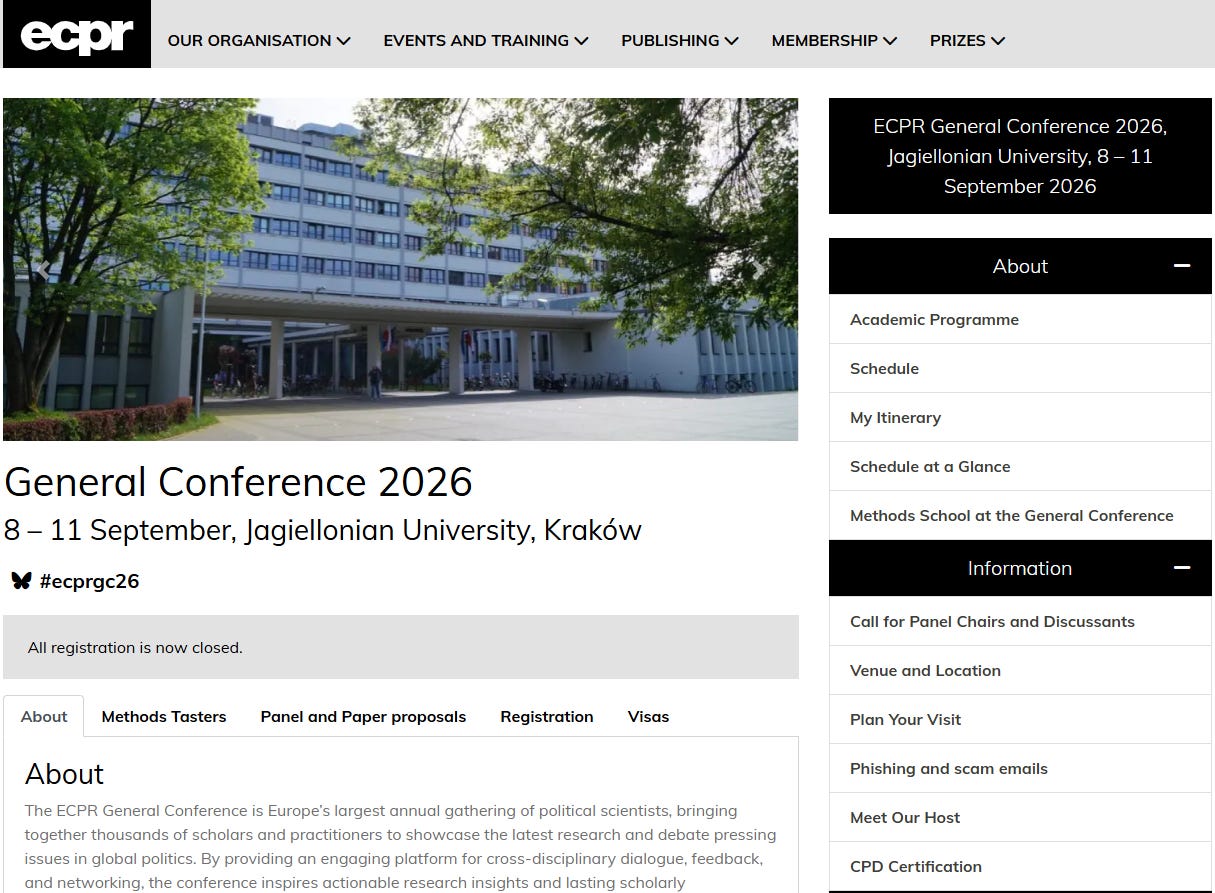
The ECPR General Conference 2026 is Europe’s largest annual gathering of political scientists. More than 2,000 scholars are descending on Kraków for four days of panels and presentations from Tuesday 8 to Friday 11 September 2026.
Curious about the event’s political makeup, I asked ChatGPT Pro (GPT-5.6 Sol) to conduct a systematic screening of the publicly accessible conference programme and available information about its presenters. My goal was to find scholars who could be reliably associated with non-left intellectual traditions—specifically, classical liberals, right-libertarians, liberal conservatives, conservatives, and traditionalists. These are not fringe traditions. They constitute the major currents of modern right-wing political thought and command the allegiance of a substantial part of the European electorate. At a conference of this scale, one would naturally expect at least some visible representation.
The result: among more than 2,000 speakers, the screening failed to identify a single scholar working within a right-wing intellectual tradition. I then ran a control question, reversing the ideological direction of the search. It found multiple presentations explicitly drawing on left-wing thought.
I followed this with a more extensive check, focusing on the individual panels, paper abstracts, and publicly available information about the speakers. Same results.
I am sharing the prompts and the relevant parts of the responses so that readers can replicate the exercise themselves. The analysis reflects the conference’s public programme as of September 6, 2026.
PROMPT:
Please examine the official website of the ECPR General Conference 2026 (link below). Review every single panel, presenter, and paper, and identify any presenter—if any exist—who represents a non-left-wing perspective. This includes, among others, classical liberals, right-libertarians, liberal conservatives, conservatives, and traditionalists:
https://ecpr.eu/Events/AcademicProgramme/Programme?EventID=349
CHAT GPT:
I went through the publicly accessible ECPR 2026 programme with your criterion specifically in mind. The result is striking: I have not found a presenter whom I can reliably identify as a right-libertarian, classical liberal, liberal conservative, conservative, traditionalist, or national conservative on the basis of explicit public self-identification or comparably unambiguous evidence. I did find one explicitly self-described centrist liberal, plus several presenters whose papers are unusually relevant to non-left intellectual traditions.
[...]
If by “not left wing” you mean someone publicly identifiable as belonging to the broad right—from classical liberalism through liberal conservatism to traditional conservatism—I have found no securely verified example in the public programme. If you include self-described political centrists, then Daniel Brieba is the one clear case.
[...]
And one thing is unusually conspicuous: despite searching specifically around classical liberalism, libertarianism, conservatism, Christian Democracy, national conservatism, Hayek, Smith, free markets, traditionalism, religion, sovereignty and the institutions where one might expect such scholars to appear, I found essentially no clearly self-identified representative of the classical-liberal or conservative intellectual traditions. Given a conference containing 2,000+ political scientists, that is itself noteworthy—although it would require attendee-level data, rather than this screening, to make any rigorous claim about ideological representation.
PROMPT:
Please examine the official website of the ECPR General Conference 2026 (link below). Review every single panel, presenter, and paper, and identify any presenter—if any exist—who represents a non-right-wing perspective. This includes, among others, left libertarians, liberal egalitarians, social democrats, socialists, and left anarchists:
https://ecpr.eu/Events/AcademicProgramme/Programme?EventID=349
CHAT GPT:
Yes. The programme contains multiple presentations whose stated intellectual or normative orientation is clearly outside the right, including explicitly socialist, liberal-egalitarian, anti-neoliberal/commoning, and feminist work.
I would not convert that into “Professor X is personally a socialist/liberal/leftist,” because a scholar’s research does not establish their private political beliefs. But if your practical question is “Are there presenters at this conference presenting work from recognisably non-right-wing traditions?”, the answer is unequivocally yes.
[...]
I didn’t count someone merely because they study the radical left, unions, redistribution, feminism or the far right. For example, Anna Paczesniak is presenting research on strategies of centre-left and radical-left parties; that establishes the object of her research, not her own politics. Similarly, I wouldn’t classify somebody as left simply because their paper criticises or empirically investigates a far-right movement.
PROMPT:
Is there a way for you to thoroughly check every speaker at the conference and their presented work to calculate a clear percentage of openly left-wing versus right-wing scholars? You should check every relevant subpage on the conference website, starting with these two and their internal links:
https://ecpr.eu/Events/AcademicProgramme/Schedule?eventID=349
https://ecpr.eu/Events/AcademicProgramme/Programme?EventID=349
CHAT GPT:
I systematically mapped the main General Conference panel sequence and screened it for ideological/intellectual traditions on both sides. The most important finding is that the asymmetry we previously identified survives this considerably more demanding test. The conference contains a great deal of scholarship about the Right, including conservatism, nationalism, Christian values, populism and radical-right parties. But that is different from finding scholarship from within right-wing intellectual traditions.
I have done a broad programme-wide panel audit and systematic searches of the publicly indexed paper corpus, followed by external investigation of ideological candidates.
[...]
There is therefore one percentage that is mathematically true of the securely identified left/right cases so far:
Securely classified left/right scholars: 100% left, 0% right.
Commentary
Europe’s largest and most important political science conference does not include a single publicly identifiable scholar working within the broad political traditions supported by roughly half the European electorate. To be clear, scholars studying right-liberal, conservative, and radical-right ideologies were plentiful. That distinction is fundamental. An intellectual tradition is not represented within political science merely because scholars place it under a microscope. Conservatism is no more represented by a paper explaining conservative voting behaviour than socialism would be by a panel analysing socialist party dynamics. Representation requires scholars who reason from within a tradition—who take its premises seriously, develop its concepts, and use them to interrogate competing accounts of political life.
This matters because political traditions do not simply offer different answers to questions that have already been agreed upon. They also shape what appears politically significant and therefore worthy of explanation. They determine which concepts are analytically useful, identify and define social problems and their legitimate solutions, and influence what counts as a satisfactory account of political phenomena. Methodological diversity cannot compensate for the absence of this kind of intellectual pluralism. A discipline may contain considerable variation in methods and subfields while remaining highly homogeneous in the ideological assumptions that organise its inquiries.
How should political science—an academic discipline that, more than any other, should value ideological diversity—address this state of affairs?
Three primary responses are possible.
The first possibility is to say that the political orientation of academic communities is irrelevant provided ordinary professional standards are satisfied. By this logic, if Europe’s largest political science conference included more than 2,000 speakers but virtually no identifiable left liberal, socialist, feminist, or Marxist among them, there would likewise be no reason for concern. This position is logically consistent but difficult to reconcile with academia’s otherwise obsessive focus on representation, inclusion, and the social conditions under which knowledge is produced. If systematic exclusion distorts institutions in every other context, there must be some compelling argument for why ideological homogeneity among those who professionally study politics is somehow epistemically harmless. This is especially true when some of those same scholars loudly claim to value political pluralism.
The second possibility is that ideological homogeneity is a product of truth-seeking procedures or moral progress. In this view, political science is overwhelmingly left-wing because sustained exposure to evidence and rigorous argument disproportionately leads competent scholars toward left-wing conclusions. Right liberals and conservatives simply lost the argument. One cannot rule that possibility out a priori, but one cannot infer it from the mere existence of an academic consensus, either. Scholars select the research questions, construct the literatures, recruit colleagues, train doctoral students, review manuscripts, award grants, and determine which controversies merit sustained attention. The more homogeneous an epistemic community becomes, the harder it is to distinguish genuine intellectual convergence from the cumulative effects of systemic selection bias and epistemic reinforcement [1]. Consensus is only a reliable proxy of soundness when empirical and theoretical conclusions survive relentless assault from peers operating from fundamentally different premises. When an epistemic community becomes intellectually homogeneous, consensus ceases to act as a reliable proxy for truth. The internal mechanisms of criticism have simply evaporated, leaving no one with the institutional leverage to apply sustained intellectual pressure. Furthermore, as J. S. Mill argued, even true beliefs risk hardening into dogma when insulated from serious opposition. We understand the foundation of our ideas much better when they are repeatedly tested against intelligent disagreement. Thus, the case for viewpoint diversity becomes stronger—not weaker—when certain political positions enjoy overwhelming institutional dominance. This is especially true in political science, where, unlike in physics or mathematics, scholars tend to have an emotional or moral attachment to, or distaste for, certain findings or logical deductions.
This leaves the third possibility: that substantial viewpoint diversity among intellectual elites is an indispensable part of the infrastructure of an open society. In this view, the situation revealed by the ECPR programme is not a mere statistical curiosity. It is a disciplinary failure. Political science has a distinctive obligation here because political disagreement is its literal subject matter. A discipline devoted to understanding conflicts over liberty, equality, authority, tradition, markets, nationhood, religion, and state power should contain scholars who approach those conflicts from the principal traditions that structure them in society. If major traditions appear overwhelmingly as objects to be analysed rather than as intellectual positions from which analysis is conducted, the discipline is not merely politically unbalanced—its capacity to fulfil its analytical role is crippled.
A simple hypothetical scenario makes the ideological asymmetry revealed here especially difficult to defend. Imagine a European political science conference containing more than 2,000 scholars but virtually no identifiable liberal egalitarians, social democrats, socialists, feminists, or Marxists. It would immediately raise serious questions about the intellectual openness and objectivity of the discipline. These questions would be entirely justified. The same standard should apply when the missing traditions are right-liberal or conservative.
This is not an argument for ideological quotas. An academic discipline cannot guarantee that political traditions will be represented in perfectly equal proportions. (Elsewhere, I have advanced possible solutions from a classical liberal perspective.)
Whatever the solution, however, complacency is not an adequate response. When Europe’s largest political science conference can assemble over 2,000 scholars to present their work, yet right-leaning thought appears solely as an object of study rather than a voice in the room, the discipline clearly has a viewpoint-diversity problem. If political scientists—especially those on the left who identify as liberals—are serious about their commitment to political pluralism, they should regard this imbalance not as an anomaly to be rationalised, but as a problem to be corrected.
Notes
1. Indeed, there is considerable evidence suggesting that this has been occurring across the broader social sciences. See, e.g., Honeycutt (2023), Peters et al. (2020), Shields and Dunn, (2016).
References
Honeycutt, N., Jussim, L. (2023). Political Bias in the Social Sciences: A Critical, Theoretical, and Empirical Review. In: Frisby, C.L., Redding, R.E., O’Donohue, W.T., Lilienfeld, S.O. (eds) Ideological and Political Bias in Psychology. Springer, Cham.
Mill, J. S. (2015 [1859]). On Liberty, Utilitarianism and Other Essays. 2nd edn. Edited by Mark Philp and Frederick Rosen. Oxford: Oxford University Press.
Peters, U., Honeycutt, N., De Block, A., & Jussim, L. (2020). Ideological diversity, hostility, and discrimination in philosophy. Philosophical Psychology, 33(4), 511–548.
Shields and Dunn (2016). Passing on the right: Conservative professors in the progressive university. Oxford University Press.
Federico Tabellini is a PhD student in the Politics and International Studies programme at the University of Warwick
Wow, could you do this for APSA? There was a behind the scenes effort to do a plenary on the 250th anniversary of the Declaration of Independence---it failed. By my count only 29 of several thousand presentations mentioned the Declaration, and by titles, most seemed negative.
Discipline failure is a serious issue, especially within a discipline that itself has an aim of addressing contradictions. That Political Science, with AI assist, is shown as highly lopsided ideologically is troubling. Hopefully, there will be follow up and corrections considered.
In my interest, as a consumer and long time advocate for education reform, I came across this book: Education in Political Science: Discovering a Neglected Field, Ed. by Anja P Jacobi, Kersten Martens and Dieter Wolf, 2010. Ironically, this was a joint publication of Routledge and ECPR. ECPR was the subject of the article by Federico Tabellini about the discipline failure of a recent ECPR Conference.
In the preface we read "May the current volume indeed turn out to be something like the starting gun for a movement towards a more intense and reflected debate about the directions of education reform." That was written over a decade ago — before our present new analytic tool of AI. Our education systems, with their evermore suffocating obstacles to reform, need serious political science attention. Institutional inversion to bring education to the service of the public, not the system, needs serious consideration. Time to rediscover education by the political scientists.